Category: news
6 reasons why planning for your future is easy to delay
Organising your finances and planning your future are important tasks. Yet, it’s something that many people put off. Procrastination isn’t simply a lack of discipline. It’s often linked to stress, fear of failure, and other psychological factors, and working with a financial planner could help overcome these obstacles.
Even if you have a financial plan in place, you might delay steps you need to take to keep everything on track. You might skip updating your goals as they change or put off reviewing the performance of your investments, even though you know it’s something you should tackle.
Here are six reasons why it’s easy to delay financial tasks and how a financial planner could help you have the confidence to manage your finances now.
1. The present may take priority
A key challenge when creating a long-term plan is that you need to balance it with your short-term needs. One reason you might delay considering future goals is that you’re focused on tasks that have an immediate impact on your life.
This short-term perspective could mean you don’t engage with long-term goals, such as retirement, for years, causing you to miss out on potential opportunities to secure the future you want.
It can sometimes feel like you have to choose whether you want to enjoy life now or secure your future. A financial plan could help you assess how you might strike the right balance for you.
2. Large goals can feel daunting
Large, long-term goals may feel impossible to reach, so you might not want to think about them.
Retirement is a good example of this. If you want to retire in your 60s, you’ll often need to save enough to generate a pension income that will cover your needs for several decades.
Legal & General research (16 December 2025) found that the happiest retirees have an average total monthly income of £1,700. If you’re eligible for the full State Pension, the data suggests you’d need a pension of approximately £172,500 to bridge the gap.
That figure can feel daunting when you first start contributing to a pension, so much so that you avoid reviewing it.
Working with a financial planner could help you break large goals into smaller ones so they feel manageable. They could also highlight other factors that could support your efforts. For example, once you factor in employer contributions, tax relief, and potential investment returns, the amount you need to contribute to your pension may feel more achievable.
3. Too many financial decisions might feel overwhelming
Day-to-day, you’ll need to make financial decisions, from what groceries to buy to whether you should switch energy providers to get a better deal. It might mean you have decision fatigue, so you leave the long-term decisions for another day.
A financial planner could make the decision-making process easier. They’ll work to understand your needs, goals, and challenges, so they’re able to offer tailored advice. Knowing there’s someone you can trust to answer your questions also removes the hours you might spend researching areas like tax allowances or investment risk.
4. Talking about finances may feel taboo
Making financial decisions might involve speaking to others. You may need to discuss household budgets or what’s important to you in retirement with your partner. For some, this can be uncomfortable.
Indeed, according to Barclays (2 April 2026), 50% of people say money feels like a taboo subject and 29% avoid conversations about finances even if it would help their situation.
Working with a financial planner on an ongoing basis could be useful here. It provides a designated time and space to talk about your finances and the impact your decisions could have on your life.
5. A fear of judgement
Everyone has made a financial decision they regret at some point. Whether you relied too much on credit when you were younger or invested in an asset that later lost money, these experiences and the fear of judgement could mean you delay engaging with your finances now.
A survey of UK adults noted in Money Marketing (16 June 2026) that people who often avoid discussing money do so because they’re concerned about being judged or that it will be perceived as a sign of failure.
A financial planner is there to help you understand how to use your assets to achieve your long-term goals, establish positive money habits, and support you, not judge you for how you’ve handled your finances previously.
6. The “I’ll do it later” mindset
Will it make a difference if you review your pension today or tomorrow? The answer is probably not, but this mindset of delaying tasks could mean things you’ve meant to get around to aren’t addressed for months or even years.
Working with a financial planner means you’ll have regular meetings scheduled, and they’ll contact you if a review needs to be carried out sooner. It might mean you’re less likely to skip important financial tasks.
Contact us
To arrange a meeting to discuss how we could help you review your finances and goals, please get in touch.
Please note: This article is for general information only and does not constitute advice. The information is aimed at individuals only.
All information is correct at the time of writing and is subject to change in the future.
A pension is a long-term investment not normally accessible until 55 (57 from April 2028). The fund value may fluctuate and can go down, which would have an impact on the level of pension benefits available. Past performance is not a reliable indicator of future performance.
The tax implications of pension withdrawals will be based on your individual circumstances. Thresholds, percentage rates, and tax legislation may change in subsequent Finance Acts.
The psychology behind investment mistakes
Have you ever made an investment mistake? Looking back at what led to the mistake could help you identify potential triggers that might prevent you from repeating the error.
When you first think about why an investment decision was “bad”, the lower-than-expected investment returns may be what comes to mind. As you contemplate what led to your decision, you might link it to a lack of information or factors outside your control.
While these may have played a role, there are often psychological reasons behind your choices. Investment decisions are often influenced by emotions or biases, which could lead to investors acting irrationally.
Here are four psychological reasons why investors make mistakes.
1. Emotions could cloud your judgement
Investment decisions should be based on data, such as risk profiles or expected investment returns. Yet, this is rarely the case, as emotions are often involved. Even experienced investors can be affected by their emotions at times.
Consider periods of market downturns. Seeing the value of your assets fall could spark fear that might lead to hasty decisions, such as withdrawing your money because you’re worried that values will drop further.
The emotions that affect your investment decisions aren’t caused only by market movements or your finances. Perhaps work has been stressful, so you seek certainty and reduce your investment risk. Alternatively, a sense of security in your life could lead you to feel more comfortable taking investment risk.
2. Overconfidence may tempt you to try to time the market
Everyone would like to purchase assets at a low price and sell when the value peaks. The problem is that markets are often unpredictable, and the values of assets are prone to experience peaks and troughs that are impossible to consistently time.
Rather than achieving the highest returns possible, trying to time the market could mean you miss out on long-term growth opportunities. As a result, it often makes sense for investors to invest in a wide range of assets that align with their risk profile and hold them over the long term.
Feeling overly confident in your ability to time the market could lead you to take greater risk and disregarding your investment strategy.
3. Confirmation bias could lead you to overlook information
When you’re deciding how to invest your money, you might research different options. One of the challenges here is overcoming confirmation bias – the tendency to seek out or focus on details that support your existing beliefs.
For example, if you’ve subconsciously decided an investment decision is right for you, you may overlook information that suggests otherwise or that the valuation is likely to fall.
4. Following the crowd may feel safer
Being part of a crowd can feel safer. Making the same investments that your friends do or that you’ve read about in the newspaper can feel comforting.
Yet, large numbers of investors have been negatively affected by poor decisions. For example, in the late 1990s, the dotcom bubble developed as investors were eager to own a portion of internet companies on the expectation that their values would soar. During the crash that followed, many online businesses collapsed and investors lost money, some because they had followed the crowd.
What’s more, an investment decision can be right for one individual but wrong for another. Perhaps your colleague whose investment strategy you’re tempted to copy has different investment goals, financial circumstances, or risk profile than you. Blindly following the investment decisions of others could lead to decisions you later regret.
There are ways to limit the impact of emotions and bias
You can’t remove emotions and bias from your investment process entirely; they’re part of being human. However, there are steps you might take to reduce their impact.
Taking a break before making large financial decisions could allow strong emotions to settle. You might benefit from having clear goals you can refer back to. In addition, a financial planner could provide you with a different perspective and guidance. If you’d like to talk to us about your investments, please get in touch.
Please note: This article is for general information only and does not constitute advice. The information is aimed at individuals only.
All information is correct at the time of writing and is subject to change in the future.
The value of your investments (and any income from them) can go down as well as up and you may not get back the full amount you invested. Past performance is not a reliable indicator of future performance.
Investments should be considered over the longer term and should fit in with your overall attitude to risk and financial circumstances.
Why updating your cashflow model is essential for staying on track
A cashflow model isn’t a one-off exercise. If you want to use it to inform your financial decisions, regular updates are essential.
A cashflow model is a visual representation of your wealth and how it might change in the future. While the result cannot be guaranteed, it could be a useful tool that helps inform your financial decisions.
Your financial planner will create your cashflow model by inputting data, such as your income, expenses, and the value of your assets. They will then make assumptions to project how your wealth might change. These assumptions could include the rate of inflation or expected investment returns.
You can then use the cashflow model to understand how the decisions you make could affect your future. You may use it to assess:
- Whether you have enough to retire five years early
- How contributing more to your investments now could deliver long-term results
- Whether you can afford to take a lump sum out of your estate to pass on to loved ones now.
However, a cashflow model is only as useful as the information that it contains. Using an out-of-date model could lead you to make decisions based on inaccurate data.
3 times you might benefit from updating your cashflow model
1. When your lifestyle goals change
Often when you’re creating a financial plan, you set out what you’d like your life to look like decades in the future. Naturally, some of these goals will change over time.
Perhaps you’d thought you’d like to work until you’re 65, but you’re now 55 and want to find a way to strike a better work-life balance. Similarly, an opportunity to travel more might mean you’d like to increase your monthly budget now to make the most of it.
As your lifestyle goals change, updating your cashflow model could help ensure that it continues to reflect the life you want to enjoy now and have in the future.
2. Following major life events
From getting married to selling a business, major life events could affect your goals and financial circumstances. Following these events with a financial review could help you take stock of whether you’re on track.
Imagine you’ve received an inheritance. A goal you thought was a decade away might become possible now – would you bring forward your planned timeline? Using your cashflow model could help you weigh up different scenarios, so you can assess what’s right for you.
3. To reflect factors outside your control
Factors outside your control might affect your finances. For example, a period of high inflation may mean you need to adjust your outgoings now and over the long term, or investment volatility could mean you’re no longer on track.
While there might be little you can do about these factors, understanding their potential impact could help you respond to them in a way that aligns with your wider financial strategy.
A regularly reviewed cashflow model could mean you’re better informed
An up-to-date cashflow model could highlight both risks and opportunities. You might find your investments are on track, so you could scale back monthly contributions to use the money in other ways. Alternatively, you could find a gap in your finances, and being aware of it sooner could provide a chance to bridge it.
As a cashflow model will typically show how your wealth might change over decades, even a seemingly small adjustment could have larger implications.
Imagine you’ve had a pay rise, and you decide to divert £100 of that additional income to your pension each month. As pension contributions are typically invested, there’s an opportunity for this money to grow over the long term. A cashflow model could highlight how this change might allow you to retire sooner or take a larger income once you give up work.
So, how often should you review your cashflow model?
Reviewing your cashflow model is likely to form part of your regular meetings with your financial planner. In addition, you might want to schedule meetings if you’re faced with a major decision or life event as mentioned above.
Talk to us about your cashflow model
Whether you’d like to create a cashflow model or would like to update your existing one to reflect changes in your life, we could help. Please contact us to arrange a meeting.
Please note: This article is for general information only and does not constitute advice. The information is aimed at individuals only.
All information is correct at the time of writing and is subject to change in the future.
The value of your investments (and any income from them) can go down as well as up and you may not get back the full amount you invested. Past performance is not a reliable indicator of future performance.
Investments should be considered over the longer term and should fit in with your overall attitude to risk and financial circumstances.
A pension is a long-term investment not normally accessible until 55 (57 from April 2028). The fund value may fluctuate and can go down, which would have an impact on the level of pension benefits available.
The tax implications of pension withdrawals will be based on your individual circumstances. Thresholds, percentage rates, and tax legislation may change in subsequent Finance Acts.
The Financial Conduct Authority does not regulate cashflow modelling.
2 upcoming ISA changes you should be aware of
Key changes are being made to ISAs in April 2027, and they could affect how you use the tax-efficient wrapper.
You might have read in the news or heard that the ISA allowance is being cut or that tax will now apply to cash savings. While there is some truth in these statements, without further details they’re misleading. To cut through the sometimes confusing headlines, we explain the two changes you should be aware of.
ISAs are a popular and tax-efficient way to save and invest
An ISA provides a tax-efficient way for people in the UK to save and invest. Typically, the interest or investment returns you earn from money held in an ISA won’t be liable for tax.
ISAs are popular, with about 15 million adult accounts subscribed to in 2023/24, according to HMRC (18 September 2025). During the year, approximately £103 billion was added to adult ISAs. So, they’re likely to form part of your overall financial plan, and it’s important to be aware of the changes coming into effect in April 2027.
1. The Cash ISA limit will reduce to £12,000 for under-65s
In 2026/27, you can place up to £20,000 into an adult ISA, and you may spread this across Cash and Stocks and Shares ISAs however you like.
In April 2027, the overall ISA allowance will remain at £20,000. However, the amount you can place in a Cash ISA will be limited to £12,000. You will then be able to place the remaining £8,000 of your allowance into a Stocks and Shares ISA.
There is no additional cap on the Stocks and Shares ISA. You may invest the full £20,000 allowance if it’s right for you.
As a result, if you currently place more than £12,000 into Cash ISAs each tax year, you might need to adjust your financial plan.
As well as the regulatory change, you might want to consider if investing could be appropriate for you. Cash provides security, but the value of your money will fall in real terms if the interest paid doesn’t keep up with inflation.
In contrast, investing through a Stocks and Shares ISA could offer a way to grow your assets at a quicker pace than inflation. However, investment returns cannot be guaranteed, and you could get back less than you initially invested. Due to market volatility and risk, investing often isn’t appropriate if you’re working towards short-term goals.
This new ISA rule doesn’t apply if you’re over 65. In this case, you may continue to place your entire allowance into a Cash ISA if you choose. The exception allows over-65s to rely on the stability of cash rather than potentially volatile investments, as some people adopt more risk-averse financial strategies later in life.
2. Interest earned on assets held in non-cash ISAs will be subject to 22% tax
If you hold cash in a non-cash ISA, such as a Stocks and Shares ISA, interest earned on that cash will be taxed at 22% from April 2027. This tax will apply to over-65s.
Crucially, cash held in a Cash ISA will not be subject to this tax.
As a result, it may be worth assessing what assets you currently hold in your ISAs and whether cash assets could be transferred to a Cash ISA.
Considering which assets – cash or stocks and shares – suit your needs is important when placing money in an ISA. When you’re deciding how to use your ISA allowance, answering these questions could help you decide what type of account might be right for you:
- What financial goal are you working towards?
- When do you intend to access the money?
- What level of risk is appropriate for you?
- What other assets do you hold?
Generally, if you’re saving for long-term goals (those that are at least five years away), investing may be appropriate. All investments carry risk, but this varies among different opportunities. If you decide to invest, you should assess what level of risk is appropriate for you, which a financial planner can help you with.
Contact us
If you want to understand how to make the most of your ISA allowance or how to save or invest tax-efficiently once you’ve maxed out your ISA, please get in touch.
Please note: This article is for general information only and does not constitute advice. The information is aimed at individuals only.
All information is correct at the time of writing and is subject to change in the future.
Please do not act based on anything you might read in this article. All contents are based on our understanding of HMRC legislation, which is subject to change.
The value of your investments (and any income from them) can go down as well as up and you may not get back the full amount you invested. Past performance is not a reliable indicator of future performance.
Investments should be considered over the longer term and should fit in with your overall attitude to risk and financial circumstances.
The Financial Conduct Authority does not regulate tax planning.
Explained: When Inheritance Tax could apply to gifts
Gifting assets during your lifetime has become a common strategy for reducing a potential Inheritance Tax (IHT) bill. Indeed, according to Paragon Bank (31 July 2025), 1 in 5 savers aged over 65 are passing on cash for this reason.
Yet, gifting doesn’t always mean that assets are excluded from your estate when calculating IHT, and there are a lot of misconceptions about when the tax could be applied.
Inheritance Tax may apply to your estate after you pass away
To understand if your gifts might be liable for IHT, you also need to be aware of how IHT works and when estates are liable.
IHT is a tax that’s applied to your estate after you pass away if the total value exceeds certain thresholds. The standard rate of IHT is 40%, so it could significantly reduce how much you leave behind for your loved ones.
Your estate includes your assets, such as property, savings, and investments. From April 2027, most pensions will be included in the value of your estate when assessing if IHT is due, so you might need to re-evaluate your estate’s liability with this reform in mind.
In 2026/27, there are two main IHT allowances:
- The nil-rate band, which is £325,000. If the value of your estate falls below this threshold, no IHT will be due.
- The residence nil-rate band, which is £175,000. You may use this allowance if you leave your main home to direct descendants. It will taper by £1 for every £2 that your estate’s value exceeds £2 million.
You can pass on unused allowances to your spouse or civil partner. As a result, you may be able to pass on up to £1 million before IHT is due if you’re planning as a couple.
Importantly, IHT is applied to the portion of your estate that exceeds the IHT thresholds.
So, if your estate could use both the nil-rate band and the residence nil-rate band, and was valued at £600,000, IHT would be due on the £100,000 that exceeds the thresholds. This would result in an IHT bill of £40,000.
Why gifting may not be a simple way to reduce your estate’s Inheritance Tax bill
If your estate could be liable for IHT, passing on your assets during your lifetime might seem like the obvious solution, but there are some complexities you need to be aware of.
First, keep in mind that your circumstances could change and gifts might not be recoverable if you need the assets in the future. It’s important to review gifts in the context of your wider financial plan to assess the impact they could have on your long-term financial security.
Second, not all gifts are immediately outside of your estate for IHT purposes. The following allowances may provide a way to pass on assets free of IHT:
- The annual exemption means you can give away up to £3,000 each tax year without the value being added to your estate. You can gift this sum to one person or split it between several people. You can carry forward unused annual exemptions for one tax year.
- You can also make small gifts of up to £250 per person each tax year, as long as you have not used another allowance on the same person.
- If you’re celebrating a wedding or civil partnership, you can take the opportunity to pass on £1,000 tax-efficiently. This allowance rises to £2,500 if it’s your grandchild or great-grandchild getting married, and to £5,000 for your children.
- Regular payments made to another person may be free from IHT. These gifts must be made from your regular income after meeting your usual living costs. They must also be given regularly. You might use this allowance to pay rent for your child, cover school fees, or add to a savings account on behalf of your grandchild. It’s important to keep an accurate record if you’re planning to use this allowance, as HMRC may look for an established pattern of giving.
Gifts that do not fall within these allowances will normally be considered potentially exempt transfers (PETs).
Inheritance Tax and potentially exempt transfers
PETs are gifts that might be considered part of your estate and could be liable for IHT.
If you live for seven years after passing on a PET, it will then fall outside of your estate for IHT purposes. So, gifting assets earlier in your life could make sense, but this should be balanced with assessing how it might affect your long-term finances, including if your needs change.
If you pass away within seven years of gifting a PET, IHT may be applied. The taper relief means the rate of IHT you pay on gifts falls as time passes. In 2026/27, the taper relief is:
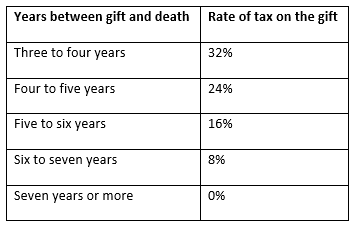
You should note that the taper relief only applies if the total value of gifts made in the seven years before you pass away exceeds the nil-rate band. As a result, if no tax is payable because the transfer does not exceed the nil-rate band, no relief can apply.
So, when assessing the potential IHT liability of gifts, you may also need to consider the wider value of your estate.
Get in touch
If you’d like to discuss your estate plan, including how you might pass on assets to your loved ones tax-efficiently, please contact us. There may be other strategies, alongside gifting, that could reduce your estate’s IHT bill.
Please note: This article is for general information only and does not constitute advice. The information is aimed at individuals only.
All information is correct at the time of writing and is subject to change in the future.
Please do not act based on anything you might read in this article. All contents are based on our understanding of HMRC legislation, which is subject to change.
The Financial Conduct Authority does not regulate Inheritance Tax planning or estate planning.
Investment market update: July 2026
Ongoing conflict in the Middle East and investor concerns that technology companies are overvalued continued to affect market performance. Read on to find out how these factors and others may have impacted your investment portfolio in July 2026.
Markets started the month with a sell-off of chip stocks as investors lost enthusiasm for AI. Asian markets were particularly affected on 2 July, with South Korea index the KOSPI suffering an 8% loss.
Despite poor job data, US markets made gains on 2 July. Some investors believed that the slowdown could ward off potential interest rate hikes, which led to the broad S&P 500 index rising 0.4%.
The view that central banks will be reluctant to increase interest rates in major economies continued to have an effect on 3 July in Europe. Main indices in the UK and Germany saw rises.
When markets reopened following the weekend on 6 July, European markets slipped. The pan-European index Stoxx 600 was down 0.4%, with the worst performer, Dutch chip equipment company BE Semiconductor Industries, down 6.8%. It was a different story in the US, where markets lifted on opening.
An Iranian attack on a tanker in the Strait of Hormuz alongside investors questioning the valuation of AI companies led to markets dipping on 8 July. London’s FTSE 100 index was 1.2% lower on opening, and indices in Italy, Germany, and the US were similarly affected.
On 9 July, the UK’s biggest pharmaceutical company, AstraZeneca, became the biggest loser on the FTSE 100 after a new heart drug failed a late-stage clinical trial. The company’s shares fell sharply by 9.2% and pulled the FTSE 100 down by 0.5%.
Tensions in the Middle East have led to oil prices rising, which is affecting airlines. On 13 July, European airline stocks fell, and the travel and leisure index on the Stoxx Europe 600 was down 1.2%. Many company shares were also affected, including Ryanair (-0.9%), Air France (-2.4%), and British Airways owner International Airlines Group (-1.9%).
The following day, ongoing strikes in the Middle East led to oil prices rising 3.5% and European shares falling in response.
Technology valuation concerns reared their heads again on 17 July. The resulting sell-off led to Japan’s Nikkei 225 index dropping almost 5%, while Japanese chipmaker Kioxia tumbled 16%. The sell-off affected European and US markets, though the FTSE 100, which has relatively low exposure to technology, fared better and was up 0.2%.
New UK prime minister, Andy Burnham, has appointed former defence secretary, John Healey, as chancellor. On 21 July, the news led to speculation that Healey would use his new position to boost defence spending. Companies in the sector saw share prices rise as a result, including Babcock International (4%), BAE Systems (2.4%), and QinetiQ (3.5%).
On 27 July, the US paused its strike on Iran, which led to European markets rallying, including the FTSE 100 (0.5%), France’s CAC 40 (1.1%), and Germany’s DAX (1.5%).
On 28 July, yet another AI sell-off saw the KOSPI fall 10%, the Nikkei 225 down 4%, and shares in chipmakers down by more than 10%. Chipmaker CXMT bucked this trend. The company debuted on the Shanghai Stock Exchange, and shares were up more than 400% on its first day of trading.
UK
UK inflation fell faster than expected, reaching a rate of 2.6% in the 12 months to June 2026.
Despite concerns that the conflict in Iran would lead to the economy contracting, data from the Office for National Statistics suggests this wasn’t the case. Indeed, the UK economy grew by 0.1% in May 2026.
Prime Minister Andy Burnham could face difficult decisions in the coming months. The Office for Budget Responsibility warned that tax rises or spending cuts will be needed to avoid debt spiralling. The risk is partly due to an ageing population. Health spending is set to reach 8% of GDP by 2030/31 and climb to 13% by 2075/76.
Purchasing Managers’ Index (PMI) readings, which measure the health of sectors, suggest the UK is struggling. In June, the manufacturing reading remained above the 50 mark at 52.5, which indicates growth, but had fallen when compared to May.
The construction downturn eased slightly, but the PMI reading remained well below the 50 mark at 38.4.
Europe
The eurozone neared its 2% inflation target in June, with a rate of 2.8% after it fell more quickly than expected. The drop was linked to a decline in oil prices and tensions in the Middle East easing. However, events during July 2026 could see inflation start to creep back up.
A factory PMI reading shows the eurozone had its best quarter in almost four years in the three months to the end of June 2026. The 51.4 reading was again linked to the Middle East conflict easing and allowing some trade to resume.
US
US inflation fell more than expected to 3.5% in the 12 months to June 2026. While this is positive news, it’s still above the target of 2%.
Job data released by the Bureau of Labor Statistics revealed only 57,000 new jobs were added in June, well below the expected 110,000. In addition, wages are falling in real terms. The data could suggest businesses are taking a cautious approach.
US president Donald Trump previously pitched trade tariffs as a way to close the deficit in the federal budget and encourage factories to return to the US. However, a Supreme Court ruling deemed the tariffs illegal, and the US has refunded $81 billion (£61 billion), leading to the deficit widening again.
US technology giant Microsoft announced it would cut 4,800 jobs, the equivalent of around 2.1% of its global workforce, in the latest round of layoffs affecting the technology sector. The news comes after shares in the business have fallen by around 19% in the year to 6 July.
Asia
China’s economic data showed GDP growth of 4.3% in the quarter to 30 June. While this figure would be celebrated in other economies, it’s one of the slowest rates on record and lags behind the target of 4.5% to 5%. The dip was linked to sluggish domestic demand.
Indeed, further data shows that China’s exports are surging. Lifted by orders for chips and computing power to support an AI boom, exports were up 27% in June when compared to a year earlier. The boost puts China on track to post a trade surplus of $1 trillion (£0.75 trillion) in 2026 for the second year running.
Speculation that fast-fashion giant Shein would unveil an IPO (initial public offering) has now been confirmed. The company has received approval from Hong Kong. However, the valuation could be lower than expected. In 2022, when Shein considered an IPO in London, it was valued at $100 billion (£74 billion), but reports suggest this will be cut significantly to around $50 billion (£37 billion).
Please note: This article is for general information only and does not constitute advice. The information is aimed at individuals only.
All information is correct at the time of writing and is subject to change in the future.
The value of your investments (and any income from them) can go down as well as up and you may not get back the full amount you invested. Past performance is not a reliable indicator of future performance.
Investments should be considered over the longer term and should fit in with your overall attitude to risk and financial circumstances.
The £12.3 billion cost of delaying estate planning
Affluent families who delay estate planning could miss out on chances to reduce a potential Inheritance Tax (IHT) bill and pass more on to their families. Find out if you could benefit from considering IHT and how you might pass on assets tax-efficiently.
According to a report covered by Today’s Wills and Probate (5 June 2026), delays in estate planning could cost UK families £12.3 billion when changes mean pensions will form part of your estate next year.
Under the current rules, most pension wealth sits outside your estate for IHT purposes. This made pensions a useful way to pass on wealth. However, for many pension holders, that will change on 6 April 2027, as most pensions will be included in IHT calculations.
However, the new pension rules don’t account for all potential IHT savings. Indeed, £7.9 billion of the total sum is attributed to delaying estate planning.
The report states that a person beginning estate planning at 50 and making use of multiple strategies, such as exemptions, reliefs, and business relief investments, could, on average, pass on £397,000 more to loved ones than those who delayed estate planning until they were 70.
1 in 5 homeowners could be overlooking a potential Inheritance Tax bill
There are many reasons why families delay estate planning
It might seem like something you don’t need to worry about until later in life, or you may mistakenly believe your estate will not be liable for IHT when you pass away.
Yet, you could be closer to the IHT threshold than you think. According to an article in MoneyAge (16 June 2026), a study of homeowners aged 45 and over found that 1 in 5 people with estates worth more than £1 million describe themselves as “just getting by”.
In 2026/27, the nil-rate band is £325,000. If the total value of your estate is below this threshold, no IHT will be due. In many cases, if you leave your main home to a direct descendant, you can also use the residence nil-rate band, which is £175,000 in 2026/27.
You may pass unused allowances to your spouse or civil partner. As a result, you might be able to pass on up to £1 million before IHT is applied to your estate.
That might seem like a significant amount. However, your estate covers your assets, such as your home, investments, and personal possessions, as well as your pension from 6 April 2027. So, it is possible to unexpectedly leave your loved ones with an IHT bill.
Estate planning isn’t just about IHT either. It includes setting out how you want to pass on your assets so they go to your intended beneficiaries, as well as planning for your security later in life. So, even if your estate won’t be liable for IHT, you could still benefit from an estate plan.
4 gifting allowances that could reduce your estate’s Inheritance Tax bill
Gifting assets during your lifetime could reduce a potential IHT bill. However, it’s not as straightforward as simply transferring assets to your loved ones.
First, it’s important to be aware of how a gift could affect your long-term financial security. A financial plan could help you assess the potential impact.
Second, not all gifts are immediately excluded from your estate for IHT purposes. Some may be included in your estate and subject to a tapered IHT rate should the value of all your assets exceed IHT thresholds.
Using these four gifting allowances as part of your wider estate plan could provide a tax-efficient way to pass on assets.
- Annual exemption
The annual exemption allows you to give away up to £3,000 each tax year without the value being added to your estate when calculating IHT. You may gift this sum to one person or split it between several people. You can carry forward any unused annual exemption for one tax year.
- Small gift allowance
Small gifts valued up to £250 can be given to as many people as you’d like each tax year, so long as you have not used another allowance on the same person.
- Wedding and civil partnership gifts
Celebrating a wedding or civil partnership also presents an opportunity to gift tax-effectively. You can gift £1,000 to the happy couple, and the gift will immediately fall outside your estate. This allowance rises to £2,500 for your grandchild or great-grandchild and £5,000 for your child.
- Regular gifts from your income
Regular payments you make to another person can fall outside your estate, so long as:
- There is an established pattern of making these payments
- The payments are made from your regular monthly income
- You can maintain your usual standard of living after making the payments.
This could provide a valuable way to support your family while reducing a potential IHT bill. For example, you might use this allowance to:
- Pay the rent or mortgage for your child
- Contribute to a savings account for your grandchild
- Provide cash to a family member that they can use for living costs.
For this allowance to be applied to your estate when calculating IHT, there needs to be a pattern of making these payments. So, it’s important to keep accurate, clear records of these gifts.
Contact us
If you’d like to understand whether your estate could be liable for IHT when you pass away, and how you might mitigate a potential bill, please get in touch.
Please note: This article is for general information only and does not constitute advice. The information is aimed at individuals only.
All information is correct at the time of writing and is subject to change in the future.
The Financial Conduct Authority does not regulate estate planning or Inheritance Tax planning.
Remember that taper relief only applies to gifts in excess of the nil-rate band. It follows that, if no tax is payable on the transfer because it does not exceed the nil-rate band (after cumulation), there can be no relief.
Taper relief does not reduce the value transferred; it reduces the tax payable as a consequence of that transfer.
How a cashflow model could provide clarity about your retirement income
Having a reliable income in retirement could give you the freedom to create a lifestyle you enjoy and achieve those bucket-list goals you’ve dreamed about for years.
In a 2023 survey by Legal & General, 94% of UK adults said their most important retirement dream is to feel financially secure for the rest of their lives.
However, working out what your income might look like many years from now can be complex. As such, you may feel in the dark about how your pensions, savings, and investments might support you in later life.
Indeed, research findings published by IFA Magazine reveal that just one in five people with a defined contribution (DC) pension understand what retirement income they can expect.
This uncertainty could leave you worried about your long-term financial security and unprepared for what lies ahead. That’s where financial advice comes in.
Keep reading to find out how a financial planner can use cashflow modelling to give you a clear picture of your retirement income and help you plan for the future you want.
The challenges of planning a sustainable retirement income
Calculating what your retirement income might be is challenging because you’re often trying to project decades ahead.
What’s more, your income could be affected by various external factors that are unpredictable and out of your control, such as investment returns and inflation.
Longer life expectancies add another layer of complexity. According to the Office for National Statistics’ (ONS) life expectancy calculator, a 45-year-old woman has an average life expectancy of 87 years, and a man of the same age could expect to live to 84.
This means that your retirement funds may need to cover about 30 years or more, depending on when you retire and your longevity. Of course, no one can predict exactly how long they’ll live, which makes it difficult to know how far your wealth will stretch.
These uncertainties could make retirement planning feel overwhelming.
A cashflow model could remove uncertainty and provide peace of mind
A financial planner can use smart software called cashflow modelling to help you plan your retirement income.
This is how it works in simple terms:
- Input data – Your financial planner enters information about your current financial position, such as your income, expenses, assets, and liabilities.
- Layer variables – They can then factor in variables such as investment performance, inflation, and your projected future income.
- Generate a cashflow forecast – The software will create a long-term projection of your finances based on your desired retirement age and life expectancy.
By tweaking the data entered, your financial planner can show you how a range of possible scenarios might affect your income. For example, you might want to see how a dip in the market or retiring earlier could affect your finances.
The power of cashflow modelling is that it removes the guesswork from retirement planning. You can clearly see how a change in your circumstances might affect your income and identify any potential shortfalls. This puts you in a strong position to adapt your strategy so that you stay on track to achieve your goals.
Your financial planner can ensure you get the most out of cashflow modelling
While there are many advantages of using a cashflow model to inform your retirement planning decisions, there are some potential drawbacks to consider too, including:
- It’s only as good as the data that’s input – Incorrect or incomplete information could result in a misleading forecast.
- It needs regular updating to be a useful planning tool – A cashflow model provides projections based on your current finances and assumptions about the future, such as the rate of inflation. This means that your model could quickly become outdated if your circumstances or external factors change.
- It requires oversight by a professional to be used effectively – A cashflow model can support retirement planning, but it can’t replace the expertise and guidance offered by a human professional.
- It could provide a false sense of security – A model can’t guarantee what your retirement income will be. It must be carefully stress-tested by a financial planner to ensure that projections are realistic and don’t appear more definite than they are. This involves exploring “what-if?” scenarios that might affect your retirement income, such as dips in the market and serious illness.
A financial planner can make sure you get the most out of your cashflow model by:
- Tailoring it to your needs and goals
- Regularly reviewing and updating it
- Stress-testing it against different scenarios
- Embedding it in your broader financial plan.
In other words, they’ll make sure your model is a valuable retirement planning tool that helps you make informed decisions with confidence.
Get in touch
If you have any questions about cashflow modelling and how it could help you gain clarity on your retirement income, we’d love to hear from you.
Please note: This article is for general information only and does not constitute advice. The information is aimed at individuals only.
All information is correct at the time of writing and is subject to change in the future.
The Financial Conduct Authority does not regulate cashflow modelling.
Investing is a skill: How to build confidence and positive habits
How do you become a better investor? It’s a skill, and like any other skill, it can be improved by forming positive habits and expanding your knowledge.
Yet, many people think successful investors are born with the skills they need. According to an Aviva survey (26 May 2026), 61% of respondents think some people are just “born investors”. While there might be personality traits that support successful investing, no one is born knowing how to invest.
42% of people who took part in the survey said they would like to change how they manage their investments, and the good news is that you can.
Investing skills can be developed through education, practice, and consistency. Even experienced investors benefit from continuous learning.
5 steps that could improve your investing confidence
Step 1: Start by learning the investment basics
It’s never too late to learn the basics of investing. There are plenty of resources available online, and your financial planner could help too.
Understanding why you might want to invest is a good place to start. While cash savings are secure, the interest rate they earn is typically below the rate of inflation. As a result, the spending power of cash assets could fall in real terms.
When you invest, you have the opportunity to achieve above-inflation returns, allowing your assets to grow in real terms. However, unlike savings, you can’t guarantee what investment returns will be generated, and there’s a risk that you’ll lose some or all of your money. The good news is that you can choose investments that align with your risk profile.
As you get to grips with the basics of investing, here are some other questions you might ask your financial planner:
- How is my risk profile created, and how does it affect what investments are suitable?
- What does diversification mean, and is it part of my investment strategy?
- Does that level of investment return mean I am on track to meet my goals?
Learning more about investing could help you feel more confident and take the plunge if a lack of knowledge has been holding you back.
Step 2: Understand the importance of goal setting
It can be easy to think that the most important thing about investing is the returns generated. However, that’s just a number; what you really want to know is whether the returns will support your long-term goal.
So, take some time to think about why you’re investing. Perhaps you want to build a nest egg for retirement or to fund your child’s education. Your goal will affect important factors, such as the investment time frame and what level of risk is appropriate.
Having a clear objective could also help you maintain your focus and mean you’re less likely to stray from your investment strategy.
Step 3: Start by investing small amounts
Many people learn and build confidence by doing something themselves. Consistently investing, whether that’s through a pension or a Stocks and Shares ISA, could help forge positive money habits.
You don’t need to invest a large sum to get used to market movements. Even transferring £20 a month into an investment account could help establish good habits.
Step 4: Learn to trust your investment strategy
One challenging investment skill to learn is patience. Once you’ve invested your money, you might feel like you should be doing something, such as tracking daily market movements or searching for a new opportunity.
Yet, for many investors, investing in line with your strategy and holding assets over a long-term time frame makes financial sense. Mastering the discipline to sit back and trust your strategy can be difficult.
Tuning out the noise could make it easier to build this skill. Limit the time you spend reading newspapers or visiting social media channels that you know are likely to have market updates. Avoiding investment news until it’s time to review your portfolio’s performance could help you avoid making mistakes due to impulsive decisions.
Step 5: Continue asking questions and learning
Finally, don’t be afraid to ask questions, even if you’ve set an investment strategy. Whether you want to understand whether investment returns are on track to meet your goals or why a particular investment is suitable for you, your financial planner can continue to offer guidance.
Get in touch
We’re here to answer your investment questions and could work with you to create an investment strategy that suits your needs. Please contact us to speak to a member of our team.
Please note: This article is for general information only and does not constitute advice. The information is aimed at individuals only.
All information is correct at the time of writing and is subject to change in the future.
The value of your investments (and any income from them) can go down as well as up and you may not get back the full amount you invested. Past performance is not a reliable indicator of future performance.
Investments should be considered over the longer term and should fit in with your overall attitude to risk and financial circumstances.